

Bedrooms are personal.
Unlike a living room, which is often designed for several people, your bedroom can reflect a much more specific mood.
It can feel calm and minimal. Warm and romantic. Dark and immersive. Soft and botanical. Artistic and expressive.
Wallpaper gives you the ability to establish that atmosphere across an entire wall rather than relying only on furniture and accessories.
The challenge is choosing the right design.
Bedroom wallpaper remains a highly active inspiration category, with thousands of examples currently indexed on Australian design platforms such as Houzz and new Australian bedroom wallpaper guides continuing to appear in 2026.
Start With the Feeling, Not the Wallpaper Pattern
Before deciding whether you want flowers, stripes, landscapes or abstract wallpaper, decide how you want the bedroom to feel.
If the goal is calm, look at soft botanical designs, atmospheric landscapes, gentle textures and tonal colour palettes.
If you want a more sophisticated and dramatic room, deeper colours, chinoiserie, large florals or artistic murals can create a stronger identity.
If the room needs to feel fresh and contemporary, consider abstract forms, understated geometry, organic lines or textured wallpaper.
Choosing the feeling first makes the design decision much easier.
Should You Wallpaper Behind the Bed?
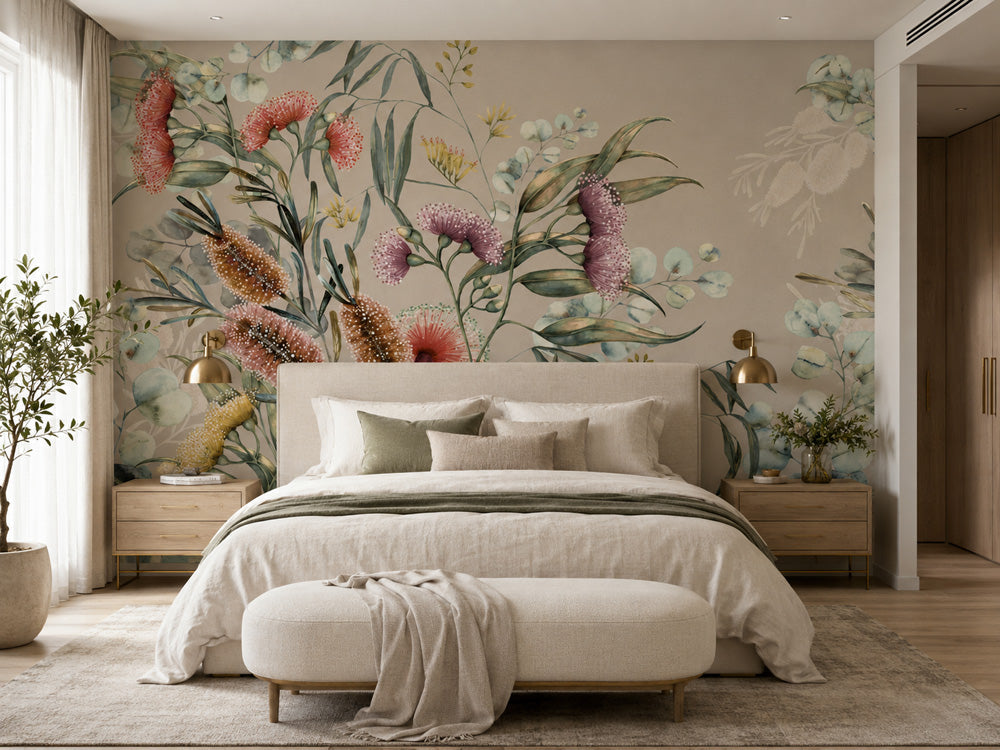
The wall behind the bed is one of the most natural locations for wallpaper.
The bed already establishes the visual centre of most bedrooms, so the wallpaper reinforces an existing focal point rather than creating a competing one.
This is particularly effective with murals because the artwork can frame the bedhead and bedside tables.
Repeating wallpaper patterns also work well behind the bed and can produce a softer, more continuous effect.
What About Wallpapering the Whole Bedroom?
Wallpaper does not need to be restricted to one wall.
Smaller repeating patterns, stripes, subtle botanicals and textured designs can work beautifully across an entire room.
Full-room wallpaper creates a more immersive atmosphere and can make the room feel intentionally designed rather than simply decorated.
The key is to consider how much visual information the wallpaper contains.
A very detailed panoramic mural might work best as the main artwork wall, while a softer repeat can wrap comfortably around several walls.
Which Wallpaper Colours Are Best for Bedrooms?
There is no universal “bedroom colour”.
Instead, think about how the colour interacts with natural light, flooring, bed linen and furniture.
Warm beige, taupe, cream and muted earthy tones can create softness without making the room feel completely neutral.
Green wallpaper works well with timber, linen and other natural materials and can create a relaxed connection with botanical themes.
Blue can range from pale and airy to dark and cocooning.
Burgundy, brown, plum and deep green can create sophisticated, intimate bedrooms when balanced with the right lighting and furnishings.
Colour-rich interiors have also remained prominent in current 2026 interior coverage, alongside a broader move toward layered, personal spaces rather than highly sterile minimalism.
Do Dark Wallpapers Make a Bedroom Feel Smaller?
They can make the boundaries of a room feel more intimate, but that is not automatically a disadvantage.
A bedroom does not always need to feel as large and open as possible.
In some spaces, a darker wallpaper creates exactly the cosy, enclosed atmosphere the room needs.
The important part is balance.
Consider ceiling height, natural light, floor colour and the size of the furniture before making your decision.
Can You Use Large Patterns in a Small Bedroom?
Yes.
A common decorating rule says small rooms should only use small patterns, but that rule is far too restrictive.
Large designs can make a small bedroom feel more intentional because the wall is read as artwork rather than as a field of tiny repeated detail.
The key is scale.
If a mural is intended for a 3.6-metre wall, compressing the complete artwork into a much smaller width may change how the composition feels.
That is where custom printed wallpaper becomes particularly useful because the artwork can be prepared around the actual wall dimensions.
Floral Wallpaper for Bedrooms
Floral wallpaper can move in several completely different directions.
Small vintage-inspired florals can create a charming and layered bedroom.
Painterly botanicals can feel more contemporary.
Large-scale flowers can become dramatic wall art.
Chinoiserie designs can introduce birds, branches, flowers and decorative storytelling for a more refined bedroom.
Recent 2026 design coverage continues to highlight romantic and pattern-rich bedrooms, including the renewed use of floral wallpaper and decorative layering.
Scenic and Landscape Murals
Landscape wallpaper works particularly well in bedrooms because it can create a sense of depth.
Forests, mountains, abstract landscapes and soft panoramic scenery extend the visual perspective of the wall and can make the space feel more atmospheric.
They also provide an alternative to hanging several individual pieces of artwork above the bed.
Textured Wallpaper for Minimal Bedrooms
If you like quieter interiors, wallpaper does not have to mean a strong pattern.
Linen-look surfaces, softly painted textures and subtle tonal designs can introduce depth without dominating the room.
Textured wall treatments are also part of the current movement toward warmer, layered interiors rather than flat, overly minimal spaces.
This can be a particularly good option when the furniture or architecture already has a strong presence.
Match the Wallpaper to the Bed, Not the Other Way Around
If you already own your furniture, start there.
Look at the timber tone of the bed, upholstery colour, bedside tables, flooring and curtains.
Then choose wallpaper that connects with some of those elements.
You do not need to perfectly match colours.
Often the strongest interiors use related tones rather than identical ones.
For example, a green botanical wallpaper can work with walnut timber, cream bedding and brass lighting without any of those elements being exactly the same green.
Always Look at a Sample in the Bedroom
Computer and phone screens are not reliable enough for final colour decisions.
Natural light changes throughout the day, and artificial lighting can also influence whether a colour appears warmer or cooler.
Place the sample against the intended wall and view it during the morning, afternoon and evening.
Also step several metres away from it.
Wallpaper is experienced as part of an entire room, not from ten centimetres away.
Choosing the Right Wallpaper Material
For a long-term bedroom interior, paste-the-wall non-woven wallpaper is a strong option.
For rentals or rooms that may change more frequently, removable peel and stick wallpaper can provide greater flexibility when installed on a suitable smooth and well-prepared wall.
Both materials allow you to focus primarily on the design while choosing an installation approach that suits your home.
Make the Bedroom Feel Like Yours
The best bedroom wallpaper is not necessarily the design currently appearing most often on Pinterest or Instagram.
It is the one that makes sense with the room, the light, the furniture and your own taste.
Wallpaper is one of the largest visual surfaces in the room, so use it intentionally.
Whether you choose a quiet texture, detailed botanical pattern, sophisticated chinoiserie wallpaper or large panoramic mural, it should establish the atmosphere you want to experience every time you enter the room.
Explore bedroom wallpaper and wall murals at Kaleon Wallpaper, custom printed in Sydney and available in a range of styles, colours and materials.


